Story, Aging, and the Art of Making Meaning
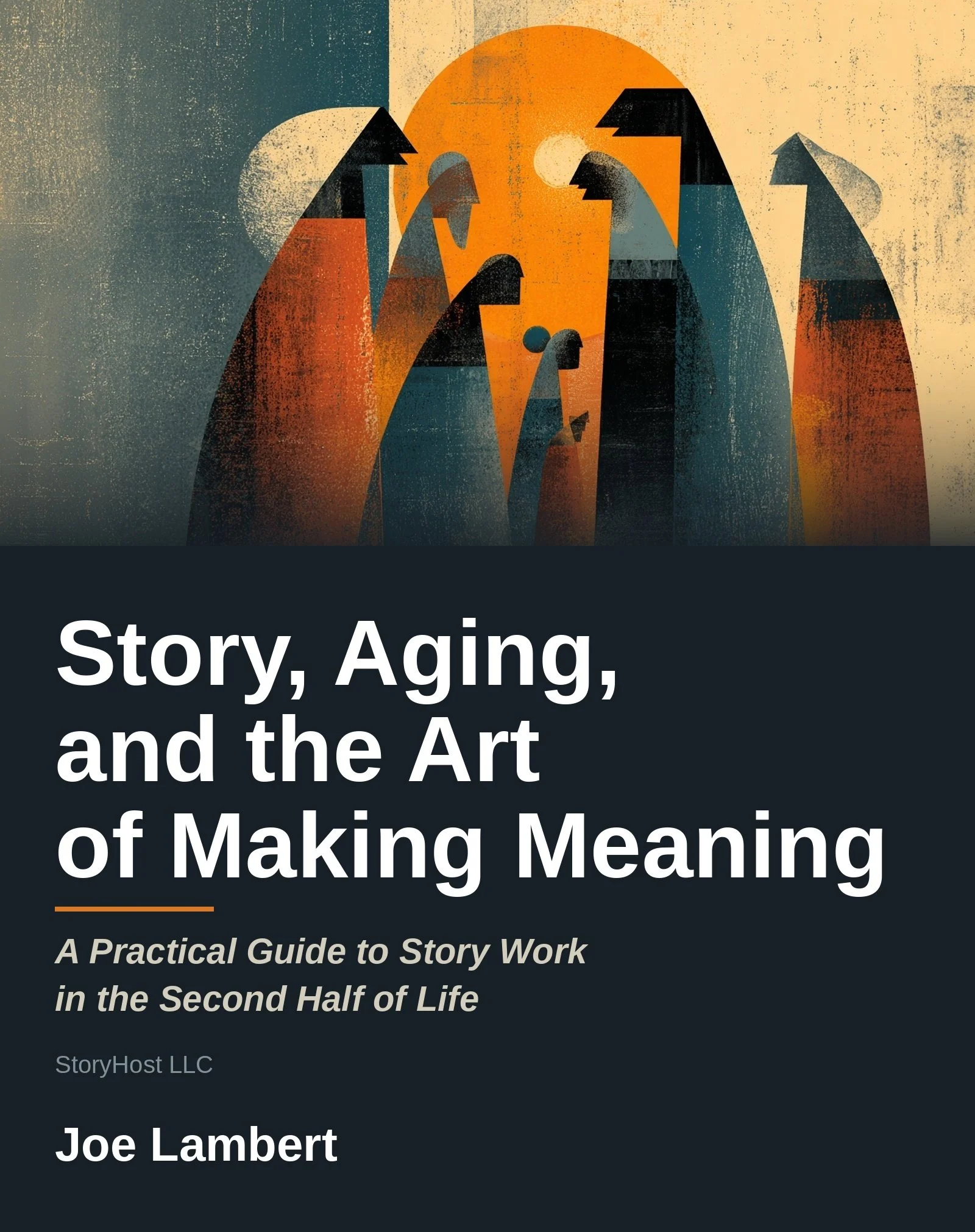
“Everything begins here, with the recognition that as we age, meaning becomes more important than motion. And story is one of the most reliable ways humans have ever found to make meaning together."
I've spent four decades as a story worker — a decade in theater, three decades building the digital storytelling movement through StoryCenter, and now this: a sustained inquiry into what story practice has to offer people in the second half of life. I've been in thousands of workshops, circles, interviews, and quiet one-on-one moments where someone leaned back, exhaled, and said, "I've never told it that way before."
This book is my attempt to understand why that moment happens. And how to make it happen more”
What's Inside
Story, Aging, and the Art of Making Meaning moves through seven parts, from the cognitive science of aging memory to the ethics of facilitation, from practical workshop design to the deep traditions behind the work.
Along the way it takes up some questions I don't think get asked often enough:
What actually happens to memory as we age — and why does it matter for the people who work with it? What does it mean to hold space for someone whose story feels finished to them, when you can hear that it isn't? What are the facilitator's responsibilities when the room contains decades of unspoken experience? And what would it look like to treat story work not as therapy, not as entertainment, but as a genuine practice of meaning restoration?
"Loneliness is the absence of company. Meaning deprivation is the absence of the feeling that your experience matters — that it is connected to something larger than itself, that the story you are living is worth the living. You can be surrounded by people and still be meaning-deprived."
The book draws on the research — socioemotional selectivity theory, the reconstructive nature of autobiographical memory, Viktor Frankl on meaning and the existential vacuum, Andy Clark on the cognitive work that objects do — but it is grounded first in practice. In what I have actually seen happen in rooms.
A Living Document
This book is being released as an ebook first — and deliberately so. I expect to revise and expand it at least once a month through the end of 2026, as I continue teaching, facilitating, and receiving feedback from readers and practitioners in the field.
Every purchase includes every update, delivered directly to you as they happen.
When a print edition comes out after January 1, 2027 — through a publisher or print-on-demand — ebook purchasers receive a 50% discount.
This is how I want to work right now: in dialogue, iteratively, with the community that has been part of building these ideas. The book is done enough to be useful. It is not so done that it can't grow.
Who This Is For
If you work with people and story in any capacity — as an educator, facilitator, community health worker, social worker, librarian, oral historian, therapist, or aging services professional — this book is written with you in mind.
If you are navigating your own later decades and trying to make sense of what story has to do with it, there's something here for you too.
And if you've been part of the Elderware community over this past year: this is what the year was building toward. Thank you for being along for the ride.
"It is about agency — about moving from being shaped by experience to being in relationship with it. From the story living you to you, carefully and with good company, beginning to live the story back."
BUY THE EBOOK — $20] PDF · EPUB · MOBI — delivered to your inbox.
“Story work offers a modest but radical counter-practice. It insists that attention is a form of care. That lived experience deserves time. That meaning is not something to be optimized or extracted, but something to be cultivated together — slowly, in community, with patience for the process and genuine respect for what each person is carrying into the room.”
About the Book
This book begins with a phone call.
My brother David is 86, going on 87. Two weeks before I called him, he and his wife Judy had moved out of the home they'd had since the 1980s, into a senior living facility in Huntsville, Alabama. He is eighteen years older than me — more like an uncle than a sibling, off into the world before I could walk. I have spent my life watching him as a distant prelude. Not close enough to see myself exactly in him, but close enough to say: that's me. That's who I will become.
That phone call is where this book starts. Because it crystallized something I've been circling for years: that as we age, meaning becomes more important than motion. And story is one of the most reliable ways humans have ever found to make meaning together..